In this article
Here is something no relocation checklist warns you about: the appraiser valuing your future home may be working with less information than an appraiser working that same market five years ago.
This is not a technology failure. It is, in a perverse way, a technology consequence.
What’s Actually Happening
As AI-driven tools have gotten better at scraping and analyzing real estate data, some sellers - and the brokers representing them - have started pulling listings off the public MLS, or removing interior photos the moment a sale closes. The reasons vary. Some sellers don’t want their floor plans and interior photos training language models they’ve never heard of. Some agents are steering sellers toward private listing networks to avoid the appearance of a long time on market, or to hide a history of price reductions. Both instincts are understandable. Neither is consequence-free.
The consequence that lands on you, as someone buying a home in a new city, is this: the appraiser your lender hires may not be able to find adequate comparable sales data to properly value the property. And if comparable sales happened off-market or inside a private network, details like interior condition, historical pricing, and how long the home actually sat before selling simply don’t exist in any accessible record.
Desiree Mehbod, a Virginia-based appraiser, put it plainly in an interview with HousingWire: “Private listing networks starve the open market of data transparency. When a property sells entirely off market or inside a private network, critical details like historical pricing adjustments, interior condition photos and true exposure time are hidden. It creates a severe data scarcity.”
Why “Remodeled” Is Not Enough
For anyone moving to a city they don’t know well, this matters more than it might seem.
When you’re relocating to Sacramento, or Raleigh, or Boise, you don’t have years of neighborhood-level intuition to draw on. You are relying heavily on the professionals in the transaction - including the appraiser - to tell you whether a price is defensible. Appraisers make that call by looking at comparable sales: homes nearby, with similar features, that sold recently. They’re not just looking at price. They’re looking at condition.
Ryan Lundquist, a Sacramento-based appraiser, explained the problem with missing photos to HousingWire: “The removal of listing photos is a growing problem and it makes it challenging to understand what someone means when they say a property has been remodeled, because was it remodeled in 1973 or 2023? Those are two very different things.”
That distinction - a gut renovation versus a contractor special from fifty years ago - can be worth tens of thousands of dollars in a valuation. Without photos of comparable sales, an appraiser is left taking an agent’s word for it.
A New Reporting Standard Arriving at the Worst Time
The data scarcity problem is colliding with a new regulatory requirement that actually demands more data from appraisers, not less.
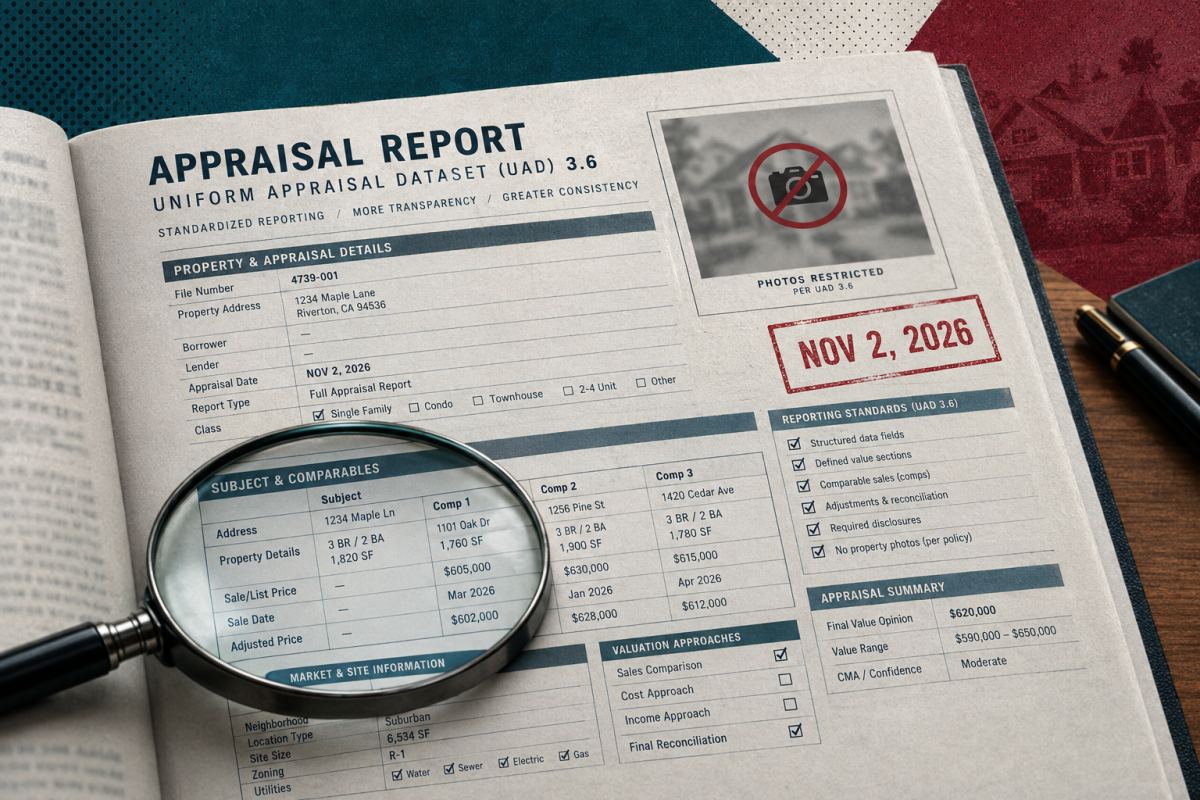
UAD 3.6 - a revised appraisal reporting standard going into effect November 2 - requires appraisers to select specific data points from dropdown menus for every feature of a property, replacing the freeform text descriptions that were standard before. Mehbod described it as requiring “a staggering amount of high resolution interior data, structural metrics and photographs.” The system is designed to produce more precise, standardized valuations. It presumes the underlying data exists to fill in those fields.
When it doesn’t, the appraiser has to go find it another way.
The Fee You Will Pay for Someone Else’s Privacy Decision
Going to find it another way takes time. Frank Gregoire, a Florida-based appraiser, told HousingWire exactly how he handles that: “I base my fee on how much time it takes to do an appraisal and complete the report and if it takes more time because I have to chase down someone for information, I am going to charge more money.”
That’s not a complaint. That’s just math. When photos are hidden and listings are private, an appraiser who wants to do the job properly has to contact the agents involved in comparable transactions directly, verify data through multiple sources, and in some cases do what appraisers did at the start of their careers - physically drive past properties to assess condition. Shawn Telford, Cotality’s chief valuation officer, acknowledged in the same HousingWire piece that this was once standard practice, and that it remains an option. It is also a slower and more expensive one.
That cost doesn’t stay with the appraiser.
What This Means If You’re Relocating
None of this means don’t buy. It means go in clear-eyed about what an appraisal can and can’t tell you in a market where private listings are common.
Before you close on anything, ask your agent how many comparable sales in that neighborhood were MLS-listed versus off-market in the past twelve months. Ask whether the appraisal your lender ordered came in with any noted data limitations. And if your appraiser had to work harder than usual to find comps - because photos were missing, or because half the relevant sales happened inside a private network - expect that work to show up somewhere in what you pay.
The seller’s privacy preference and your appraisal fee are now, quietly, the same line item.