In this article
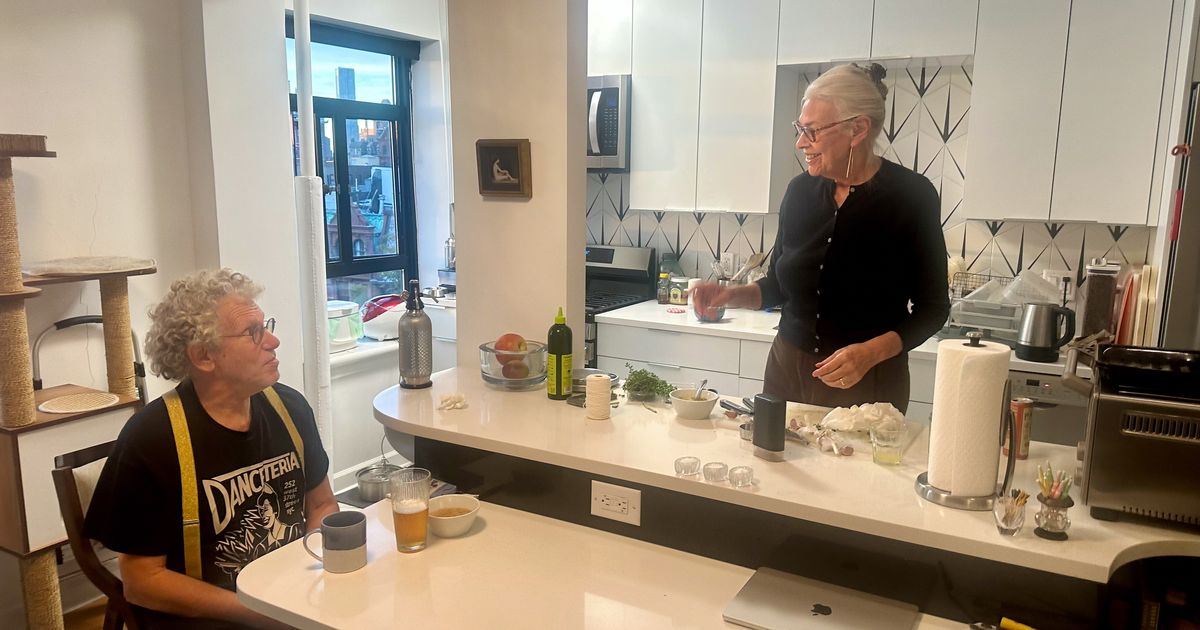
The real estate logic here is almost aggressively counterintuitive. A married couple - both in their 70s, both previously divorced - own two separate apartments in the same Brooklyn Heights co-op. He’s in 8J. She’s one flight down in 7G. They have lunch and dinner together in his place most days, coffee and cards in hers most mornings, and they entertain in hers because it’s less likely to bewilder guests. This is not a separation. It is, by their account, a solution.
Sarah Crichton is a book editor. Len is a retired research scientist. They met on OkCupid in January 2020, which means they met approximately eight weeks before New York locked down. Their early relationship unfolded the way many pandemic relationships did: fast, compressed, high-stakes. Len moved into Sarah’s Boerum Hill brownstone so they could keep seeing each other. It didn’t quite fit. Her ex-husband had lived there, which she acknowledges was uncomfortable. Len, she says, “clearly didn’t feel at home.”
That detail is worth holding onto.
What Happens When a Home Already Has a History
When people relocate - particularly people relocating as couples, or relocating to start over after a major life change - they tend to think about the new city as a blank slate. Fresh start, new neighborhood, different cost of living. What they underestimate is how much a shared physical space will either support or silently undermine that fresh start.
Len had spent two years renovating his Brooklyn Heights one-bedroom, an apartment he’d bought after ending a long previous marriage. When he finally moved in during the spring of 2022, he was, in Sarah’s word, “obsessed.” The apartment shows it. The walls are hung with wire grid panels typically used in retail display. Industrial shelving from the Uline catalogue lines the rooms. His desk is a slab of used countertop resting on a pair of old filing cabinets. Items on display include a Mad Hatter top hat, a fly swatter, bungee cords, retractable tape measures, and a supply of dog biscuits maintained on the principle that a dog might visit and he likes to be prepared. It reads, depending on your tolerance for entropy, as either an art installation or a very organized garage.
Sarah’s taste runs to Central Asian patterned rugs, cherrywood cabinets, mid-century modern furniture, and warm colors. She calls it “classic New York.” It is emphatically not what’s happening one floor up.
After they married in the fall of 2022, she moved into his place nearly full time. The apartment is a one-bedroom, roughly a quarter the size of her Boerum Hill brownstone. For a while it worked. Then it stopped. “This apartment reflects Len so powerfully,” she says. “It doesn’t reflect me.”
The Accidental Fix
The couple explored the obvious solutions first: a two-bedroom apartment they could buy together, or a studio Sarah could use as an office. Neither quite fit what they actually needed, which they hadn’t yet fully articulated. Then, about six months into the marriage, Sarah was browsing StreetEasy and found an open house that afternoon for a unit directly below Len’s. They walked in. She whispered that she wanted it. They bought it the same day.
Here is the part that makes this story relevant to anyone looking at real estate in a city they don’t yet fully understand: because this particular co-op is entangled in an unpredictable land-lease situation, the units sell for roughly half what comparable Brooklyn Heights apartments cost. Two apartments in this building cost something closer to what one apartment in a cleaner-titled building would run. That’s not a universally reproducible arbitrage - land-lease buildings carry real risk and limited financing options - but it illustrates a broader point. The weird buildings, the ones with complicated ownership structures or assessments or co-op boards that make buyers nervous, are often the ones where the math suddenly becomes possible.
What This Actually Teaches You About Moving
If you are relocating to a city - particularly a smaller, more affordable city where the gap between “fine” and “right” in housing is not always priced in - the Crichton-Berman arrangement is a useful thought experiment.
Most couples moving somewhere new default to the largest space their budget allows, on the theory that square footage solves conflict. Sometimes it does. But the more common friction isn’t about size. It’s about whose vision of home is actually being lived in. One person’s Uline shelving is another person’s daily reminder that this place was never really theirs.
The arrangement they landed on - separate spaces, connected lives, shared meals in whichever apartment makes sense - requires a specific combination of financial flexibility, geographic luck, and willingness to defy what a marriage is supposed to look like spatially. Most people won’t replicate it exactly.
But the underlying question is portable: when you move somewhere new together, whose home are you actually building? And does the floor plan you’re about to sign for have room for both answers?
Len, for the record, keeps the dog biscuits in his apartment. The dog, when it visits, seems unbothered by the Uline shelving.