In this article
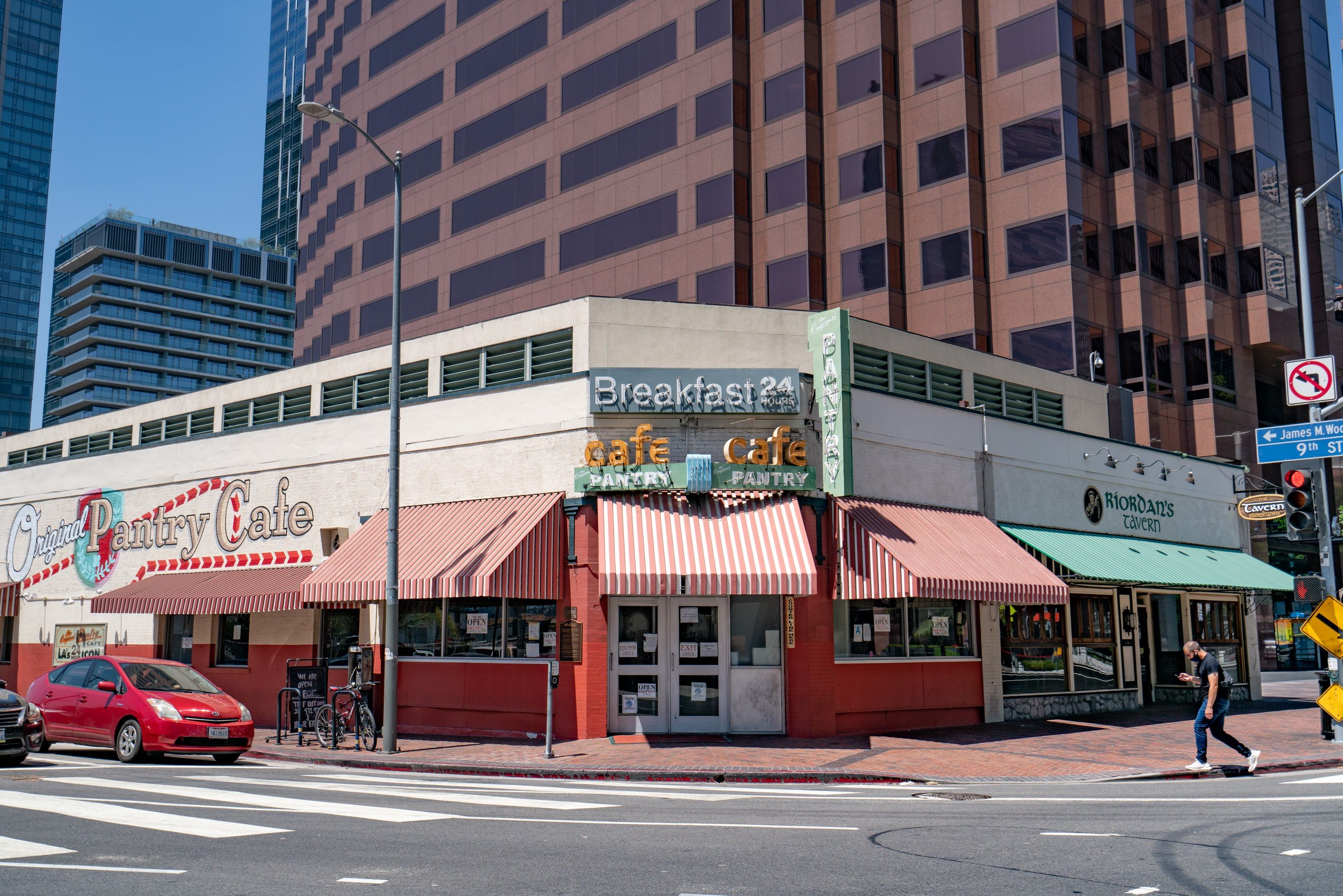
The Original Pantry Cafe operated for roughly a century without locks on its doors. Not as a gimmick - as a fact. The diner at the corner of Figueroa and Ninth Streets in Downtown Los Angeles stayed open every hour of every day for most of its existence, through the 1992 uprising, through multiple ownership changes, closing only a handful of times before the pandemic finally forced a temporary halt. When it shut for good on March 2, 2025, people waited in line for hours over the final weekend to eat ham steak and eggs, fried potatoes, and crunchy coleslaw one last time. That is not nostalgia. That is a city telling you something about what it’s losing.
For anyone evaluating a move to Los Angeles - or to any mid-size or large American city right now - the Pantry’s closure and its upcoming reopening on November 19 is worth paying attention to. Not because you’ll eat there, necessarily, but because the arc of this story is the arc of Downtown itself.
What Closed and Why
The Pantry opened in 1924. Former Los Angeles mayor Richard Riordan bought it in 1981 and ran it until his death in 2023. After that, the Richard J. Riordan family trust and the hospitality workers union Unite Here Local 11 fell into conflict over the closure, with allegations that it violated federal labor law. The trust stated the primary reason for shutting down was to “maximize the value of the real estate.”
That phrase - maximize the value of the real estate - is doing a lot of work. It is the sentence that ends neighborhood institutions across American cities, from Detroit to Denver, and it arrived in Downtown LA right on schedule. A century-old diner becomes, in the language of property valuation, an underperforming asset. Workers who spent decades behind the counter become a liability. The math is not complicated; the consequences are.
What’s Coming Back
Real estate entrepreneur Leo Pustilnikov acquired the property in September 2025 and announced a different kind of plan. The Pantry will reopen in partnership with Hope the Mission, a nonprofit serving unhoused people in Greater Los Angeles. According to SF Gate, every meal sold will help fund the organization, while the restaurant also provides job training and support to people caught in the cycle of housing instability. Pustilnikov has also reached a deal with Unite Here Local 11, and a number of former Pantry employees - some of whom worked there for decades - will return.
This is an unusual ownership structure for a diner. Whether it holds together operationally over time is a genuine open question. But the intent matters to anyone thinking about what kind of city they’re moving into: someone bought a landmark and decided not to flip it.
Downtown LA Is Not One Thing
If you’re considering relocating to Los Angeles and have been told to avoid Downtown, that advice is both understandable and about five years out of date. It’s also too simple.
Downtown LA is a collection of distinct, walkable pockets that have almost nothing to do with each other. The Arts District near the LA River is a different proposition than the Historic Core along Broadway, which is a different proposition than South Park near Crypto.com Arena, which is where the Pantry sits, on Figueroa. A two-bedroom in South Park runs considerably different numbers than a two-bedroom in Silver Lake or Culver City - generally lower, though “affordable for LA” is its own genre of qualification.
What Downtown has, and what matters to people who are relocating from cities where walkability is normal, is density of function. You can eat breakfast at the Pantry, walk to Grand Central Market for lunch, get to a Dodgers game without a car, and find a bar open past midnight within a five-minute radius. That is genuinely rare in a city built around the freeway.
The Broader Pattern
The Pantry isn’t the only institution making a comeback along these blocks. Clifton’s Republic, the cafeteria that first opened at its Broadway location in 1935, has new operators and plans to reopen. Cole’s, which began selling French dip sandwiches in 1908, shuttered in March 2026 after several extended closure dates; the Los Angeles Times reports it will reopen in March 2027 under new ownership.
Three historic Downtown restaurants, all closing within roughly a year of each other, all now pointing toward reopening. That’s either a coincidence or a signal about where Downtown investment is going. Probably both.
What This Actually Tells a Relocating Person
When a city’s oldest restaurants close, it’s usually because of one of three things: the neighborhood became too expensive for the business model, the ownership ran out of will, or the customers moved somewhere else. In Downtown LA’s case, all three applied simultaneously, and the recovery is happening anyway.
That’s not a reason to move somewhere. It is, however, a way of reading a place honestly.
The Pantry served customers through one of the worst civil unrest events in modern American history and then, forty years later, was nearly lost to a real estate calculation. It opens again November 19. The coleslaw, reportedly, is still crunchy.