In this article
When you’re evaluating a neighborhood to live in, one of the more reliable signals isn’t the coffee shop density or the walkability score. It’s whether the place has ever had to fight for anything.
The South Side Community Art Center, at 3831 S. Michigan Ave. in Bronzeville, has been fighting - and surviving - since 1941. It is the only Works Progress Administration art center still in existence in the United States. That’s not a boast. That’s an 85-year record of institutional survival in a country that has never particularly prioritized Black cultural infrastructure. If you’re moving to Chicago and wondering which neighborhoods have actual roots rather than manufactured ones, that fact belongs in your calculation.
What’s Actually Happening There
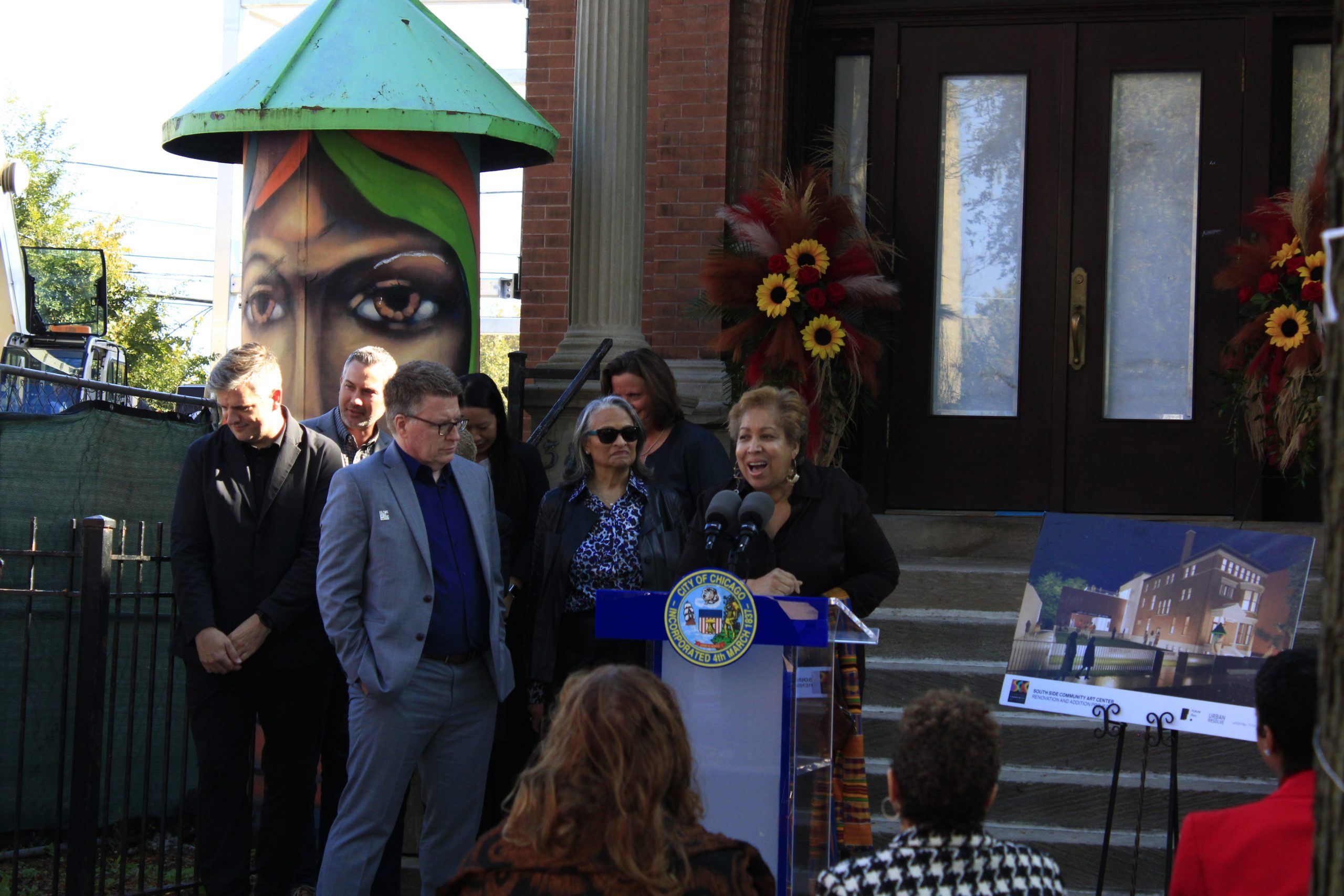
The center has been closed since construction began last year. The project - an $18 million effort, with $12.7 million raised as of October 2026 - will more than double the building’s square footage. The expansion adds classrooms for arts education, a public archive, an accessible entrance, and restores the third-floor ballroom. Galleries get expanded. The plan is to reopen by the end of 2027.
The funding came from several sources: $5 million from the city’s Neighborhood Opportunity Fund, $2 million from the Illinois Department of Commerce and Economic Opportunity, and $2 million from the Driehaus Foundation. The remaining gap is still being closed.
The building’s interior has wood paneling marked with thousands of small holes - every spot where a work of art was hung over eight and a half decades. The architects are recreating that pattern on the facade of the new addition. That’s the kind of design decision that tells you something about whether a renovation is being done with care or just with money.
Why This Matters to Someone Relocating
Here’s what the “best neighborhoods” rankings won’t say: a lot of places that get labeled as culturally rich are actually trading on a past that’s been gentrified into decoration. The murals stay; the artists leave. The jazz club becomes a themed cocktail bar. The neighborhood “has character” right up until the character can no longer afford the rent.
Bronzeville is not immune to those pressures. But the South Side Community Art Center is a counterweight, and a serious one.
The center was co-founded by Margaret Burroughs, and in its early decades it served as an artistic home for Gwendolyn Brooks, Gordon Parks, and Charles White - figures of national significance who were excluded from Chicago’s white institutions at the time. Contemporary artists including Kerry James Marshall and Faheem Majeed have continued working within its orbit. This is not a legacy that exists only in a Wikipedia article. It’s a living institutional lineage, and the expansion is designed to extend it into another generation through classroom programming for children.
Candace Hunter, an artist connected to the center, described it after the October topping-out ceremony as “a miracle of a place.” She spoke specifically about what it meant for Black children in Chicago to encounter art that looked like them - and about the new classrooms as a mechanism for keeping that going. That’s a concrete program, not a sentiment.
What Bronzeville Is Like on the Ground
Bronzeville sits roughly four miles south of the Loop, along the lakefront corridor. Housing costs vary significantly by block - a renovated greystone can run well into the mid-to-high six figures, while more distressed properties still exist within walking distance. The neighborhood has seen investment pressure for years without tipping into the total displacement that has reshaped parts of Wicker Park or Logan Square.
The stretch of Michigan Avenue where the Art Center sits is not, to be honest, a polished streetscape. There are gaps, vacant lots, and blocks that are clearly still waiting on whatever comes next. That’s worth knowing before you visit. It’s also the context in which an $18 million cultural restoration is a significant statement about what residents and funders believe the neighborhood is going to become.
A few people who walked past the October ceremony told reporters they had lived in Bronzeville for years and had never been inside the center - weren’t even sure what the building was.
That gap - between a neighborhood institution’s actual significance and how many people in the surrounding blocks know about it - is something the expansion is explicitly designed to close. Bigger galleries. A public archive. Classrooms that pull kids in from outside the existing network of people who already know what the place is.
The Honest Version
If you’re relocating to Chicago and you care about living somewhere with cultural infrastructure that wasn’t assembled last Tuesday by a real estate marketing team, Bronzeville is worth serious attention. The South Side Community Art Center is a real institution with an 85-year track record and a credible plan for the next century.
It’s also still $5.3 million short of its fundraising goal, closed for at least another year, and surrounded by a neighborhood that is visibly mid-process - whatever that process ultimately turns out to be.
The final structural beam went up in October. Mayor Brandon Johnson signed it at the ceremony. Whether the surrounding blocks look different in 2035 than they do today depends on more than one building.