In this article
The luxury rental market has a branding problem that most people only discover after they’ve signed a lease. The wide-angle Zillow photos, the staged bouclé armchairs, the AI-generated furniture floating in rooms with no square footage reference - none of it tells you what a place actually feels like to live in. You Can See Everything, the A24 documentary directed by Lance Oppenheim and shot on film by DP David Bolen with almost no artificial light, accidentally produces the most honest real estate photography of 2025. It also happens to document two specific rentals - one in Del Mar, California, and one in Austin, Texas - that are worth understanding on their own terms.
The Del Mar house at 2986 Sandy Lane is the more instructive of the two.
What $5,650 a Month (or Much More) Gets You in Del Mar
The last advertised rental listing for the property dates to 2015, when it was asking $5,650 per month. Whatever Elizabeth Holmes and her partner Billy Evans paid more recently is unclear - substacker Carson Griffith reported a figure of $28,000 a month, though the sourcing on that number is thin. Zillow currently estimates the house’s value at $8.995 million. Property records show it has transferred only within the same family since 1994, which is the kind of ownership history that usually signals an off-market arrangement rather than anything resembling a standard rental.
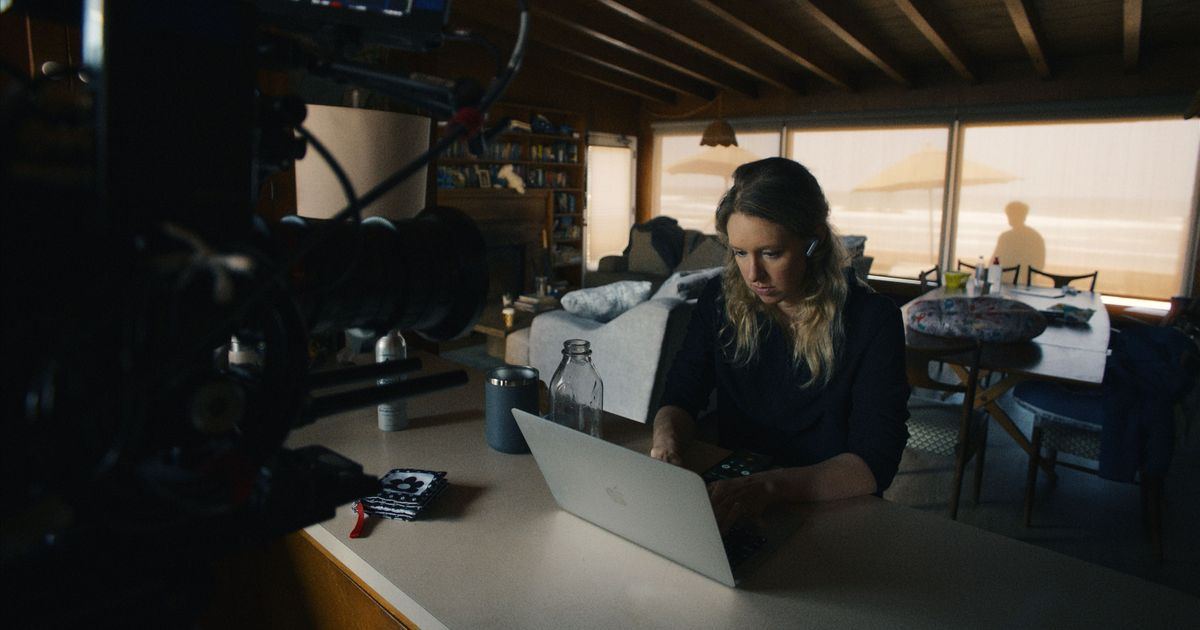
What you see in the film: honey-colored wood paneling on every wall, low ceilings, white Formica countertops, a black microwave, a stand-up shower tiled in mauve. Most of the family’s belongings are in plastic storage bins on a concrete driveway. The exterior paint is peeling. Inside, there’s a sun-faded poster of Tahiti that has clearly been there since before the internet existed.
This is a beach house that has been rented hard for decades and renovated never. The listing photos - from that 2015 posting - show the same kitchen where Holmes attempts to scramble eggs and where Amanda Seyfried asks about a French press. The space looks exactly as dated in the listing as it does in the documentary.
So why would anyone pay premium price for it? The answer, which any experienced renter in a coastal market already knows, is that you’re not paying for the house. You’re paying for the private beach access and the gated street. A local broker quoted in Realtor.com confirmed both. Evans’s family developed hotels in the San Diego area; his parents appear to have lived on the same street. The house is a vehicle for access, not a statement about taste. That distinction matters enormously when you’re evaluating what a rental price actually buys you in a market like Del Mar, where the gap between what a place looks like and what it costs can be wide enough to drive a moving truck through.
The 2018 Del Mar City Council records are also worth noting: the Evans family and the Hays family - the owners of the Sandy Lane property - jointly opposed a ballot measure that would have restricted beachfront remodeling. It passed anyway. The house, as of the filming, still needed the renovation.
Austin: Modern and Surveilled
The Austin rental at 606 Josephine Street is a different proposition. The last advertised rent was $8,750 per month. It’s currently listed for sale at $2.25 million. It’s a modern four-bedroom, shielded from the street by landscaping and a low stone fence - the kind of design choice that reads as privacy rather than curb appeal.
Evans rented it while Holmes served her sentence at a federal prison in Bryan, Texas, roughly two hours away. In the documentary, he’s raising their two children there, with a screen positioned at the dining table showing a deepfake video of Holmes. This is not a selling point in any conventional real estate sense, but the house itself represents the other end of the spectrum from Del Mar: newer construction, intentionally obscured from neighbors, in a market that has spent the better part of a decade absorbing an influx of tech money and adjusting its prices accordingly.
The Thing the Documentary Actually Shows
What Oppenheim and Bolen’s decision to shoot on film reveals - unintentionally, in the service of a story about something else entirely - is what expensive rentals look like when nobody is optimizing them for a listing. Dust motes. Cracks in the ceiling. Storage bins where furniture should be. The mauve shower.
This is closer to the truth of renting than anything you’ll see in a curated listing, and it’s particularly true in markets where price is driven by access - to a beach, to a school district, to a neighborhood identity - rather than by the actual condition of the unit. In Del Mar, you can pay well above the median for a house that hasn’t been meaningfully updated since the 1980s, because what you’re buying is the right to walk out the back gate and be on a private beach.
Whether that trade-off makes sense depends entirely on what you need. The house at 2986 Sandy Lane makes a persuasive case that it often doesn’t - and that the gap between what a rental costs and what it delivers is sometimes only visible when someone finally photographs it in natural light.
The mauve shower is still there.